ServicesRoof inspection
Roof Inspection for Buckeye Homes, From Tile to Underlayment
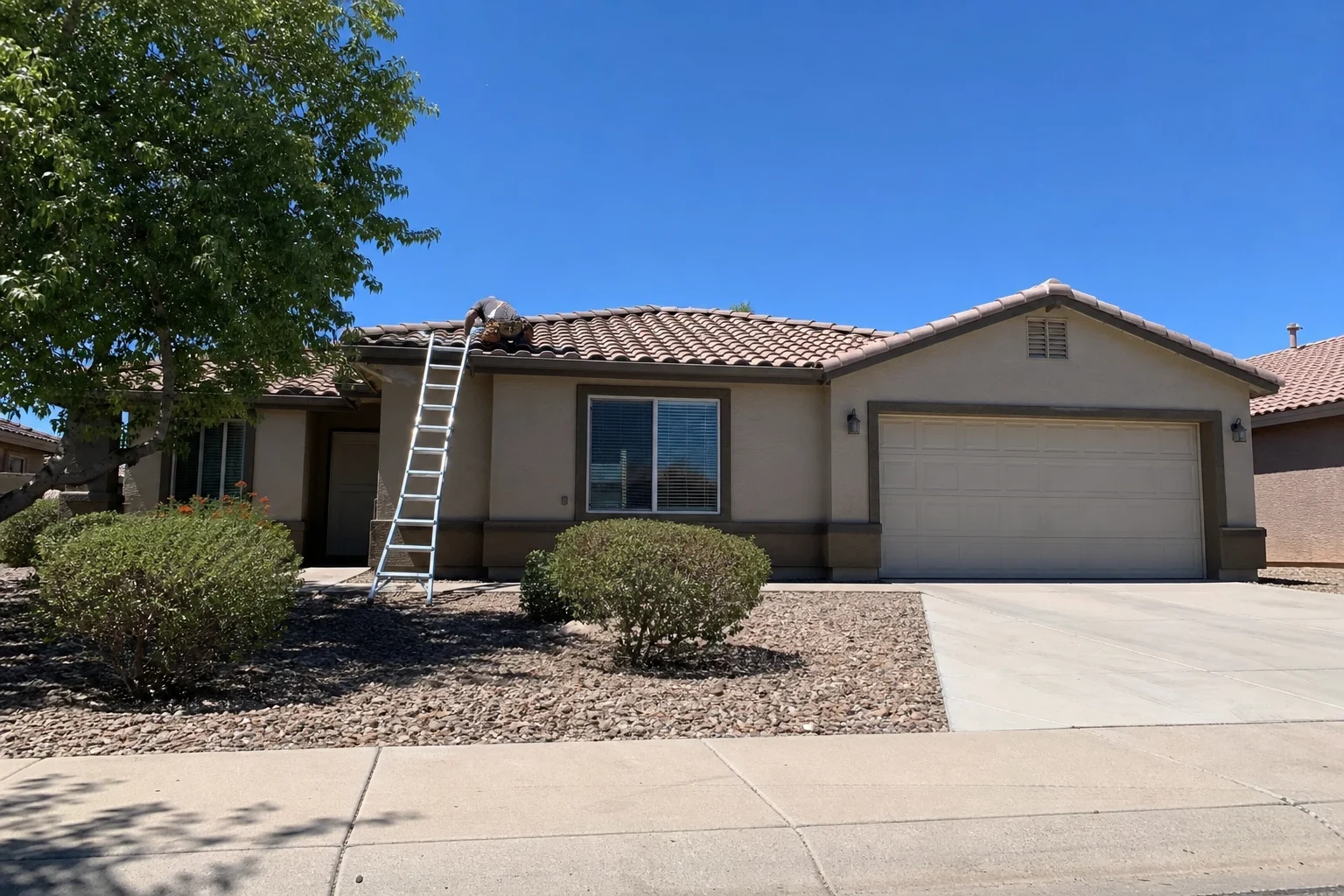
We walk your roof, check the attic and look at the layers you can't see from the street: the underlayment under the tile, the flashing at every wall and pipe, the coating on flat sections. You get photos, an account of what we found and how long each part likely has left.
What a roof inspection tells you that the street view can't
Most roofs in Buckeye are concrete tile, and concrete tile itself can last for decades. What usually wears out first is the underlayment beneath it. Summer attic heat bakes asphalt felt until it turns brittle and cracks, and once that layer splits, monsoon rain driven sideways under the tile laps has nothing left to stop it. From the ground, a roof in that state can look perfectly fine.
An inspection is how you find that out early. Resetting a few slipped tiles, sealing a lifted pipe flashing or clearing a packed valley is a small bill. Letting the same problems run until the plywood decking softens turns it into a much larger one. We look at each part of the roof, estimate its remaining life and lay out the cost now against the cost of waiting, so the money you spend goes toward the parts that will actually fail next.
What we check on every inspection
Tile field and fasteners
We look for cracked, slipped and broken tiles, missing nails or clips, and mortar that has let go at ridges and hips. Cracks often come from foot traffic during solar or satellite installs, so we check those areas closely.
Underlayment at sample points
We lift tiles at a few spots, usually at the eaves, in a valley and near a wall, to see the felt or synthetic underlayment directly. Its condition decides if the roof needs targeted repairs now or, eventually, a tile lift-and-relay.
Flashing and penetrations
Pipe jacks, furnace and water heater vents, skylight curbs, headwall and step flashing all get checked for lifted edges, rusted metal and dried-out sealant. This is where most leaks in newer homes start.
Valleys and drainage
Dust storms leave silt and debris in valley metal and behind bird stops, which slows water and pushes it sideways. We also check gutters, downspouts and scuppers where the house has them.
Flat and low-slope sections
Patio covers and flat areas behind parapets often carry foam or a rolled membrane. We look for thin or chalking coating, blisters, ponding marks and open seams at the parapet walls.
Attic and decking
Inside, we look for water stains on the sheathing, daylight at penetrations, soft decking and blocked or undersized vents. Heat trapped in the attic shortens underlayment life, so ventilation is part of the picture.
Signs it's time to have your roof inspected
- Ceiling stains after monsoon season
- A brown ring that shows up after a summer storm usually means water got past the tile and the underlayment. The stain is rarely directly below the entry point, which is why we trace it from the attic.
- Your roof is nearing 20 years
- If the house still has its original underlayment, it is reaching the age when felt under tile tends to crack in the Arizona heat. An inspection shows whether yours is holding up or close to done.
- Tiles out of line or broken
- Slipped tiles leave gaps that let water and sun reach the underlayment. A few out of place can be reset, but they are worth catching before a storm season.
- After hail, a microburst or a dust storm
- High wind can lift ridge tiles and drive debris into valleys, and hail can fracture tiles without obvious marks from the ground. If you suspect real damage, our storm damage repair page covers what comes next.
- Buying, selling or adding solar
- Knowing the roof's remaining life before a sale or a panel install keeps you from paying twice, once for the panels and again to remove them for roof work a few years later.
How the inspection day runs
- 1
A few questions on the phone
We ask about the roof's age, any leaks you've noticed and any plans to buy, sell or add solar. That tells us what to focus on and how long to plan for.
- 2
Walking the roof carefully
In summer we schedule early, before tile surfaces get too hot to work on safely. We step on the lower edge of each tile where it is supported, which keeps breakage to a minimum.
- 3
Lifting tiles and checking the attic
We lift sample tiles to see the underlayment, then reset them. Inside the attic we check sheathing, vents and every penetration from below.
- 4
Photos and a plain-language report
We walk you through the photos and sort findings into three groups: needs work now, watch over the next few years, and fine for the long haul. Where work is needed, you get a written, line-item estimate for it.
What affects the cost of an inspection
We tell you on the phone whether there is a charge for the kind of inspection you need before we set a time. The scope, not a sales pitch, sets what the visit involves. These are the things that change how much time a roof takes.
- Roof size and pitch
- A larger roof or a steep pitch takes longer to walk safely and has more valleys and penetrations to check.
- Tile versus shingle
- Tile has to be walked with care and lifted at sample points, which takes more time than reading a shingle roof from the surface.
- Two stories and access
- Taller homes, tight side yards and attics with limited access all add setup time.
- Flat sections and equipment
- Foam roofs, parapets and rooftop units such as evaporative coolers each need their own check.
- Report detail
- A homeowner walkthrough is simpler than a detailed written report prepared for a home sale or an insurance claim.
Questions about roof inspections
- How often does my roof need an inspection?
- For a healthy roof, every few years works, moving to yearly once it is around 15 years old. A check after a hard monsoon or hail storm is also a good idea. Routine inspections find tile and flashing issues while they are still minor repairs.
- Could walking my tile roof crack tiles?
- Concrete tile may crack when weight lands in the wrong spot. We step only on the supported bottom edge of each tile and stay off unsupported areas. If one does crack while we are there, we point it out and show you.
- Does someone need to be home?
- Yes, for the attic portion, since someone has to let us inside. Most homeowners prefer to be around at the end anyway to look through the photos with us.
- Is your inspection the same as the insurance adjuster's?
- No. We record the roof's condition and any damage we see, and those photos are yours to send to your insurer. Coverage is up to the adjuster; we can describe what we found and what fixing it would take.
- Will you just say I need a new roof?
- Only when the underlayment or decking is truly worn out. Many roofs just need a few specific fixes, which we would price as roof repair. If replacement is on the horizon, we give you a rough number of years left so you can plan roof replacement when it suits you rather than after a leak.
Find out how many good years your roof has left
We inspect roofs in Buckeye and nearby towns including Goodyear, Avondale, Litchfield Park and Surprise. Tell us about your roof and we'll set a time that works for your household.